2026-10-24
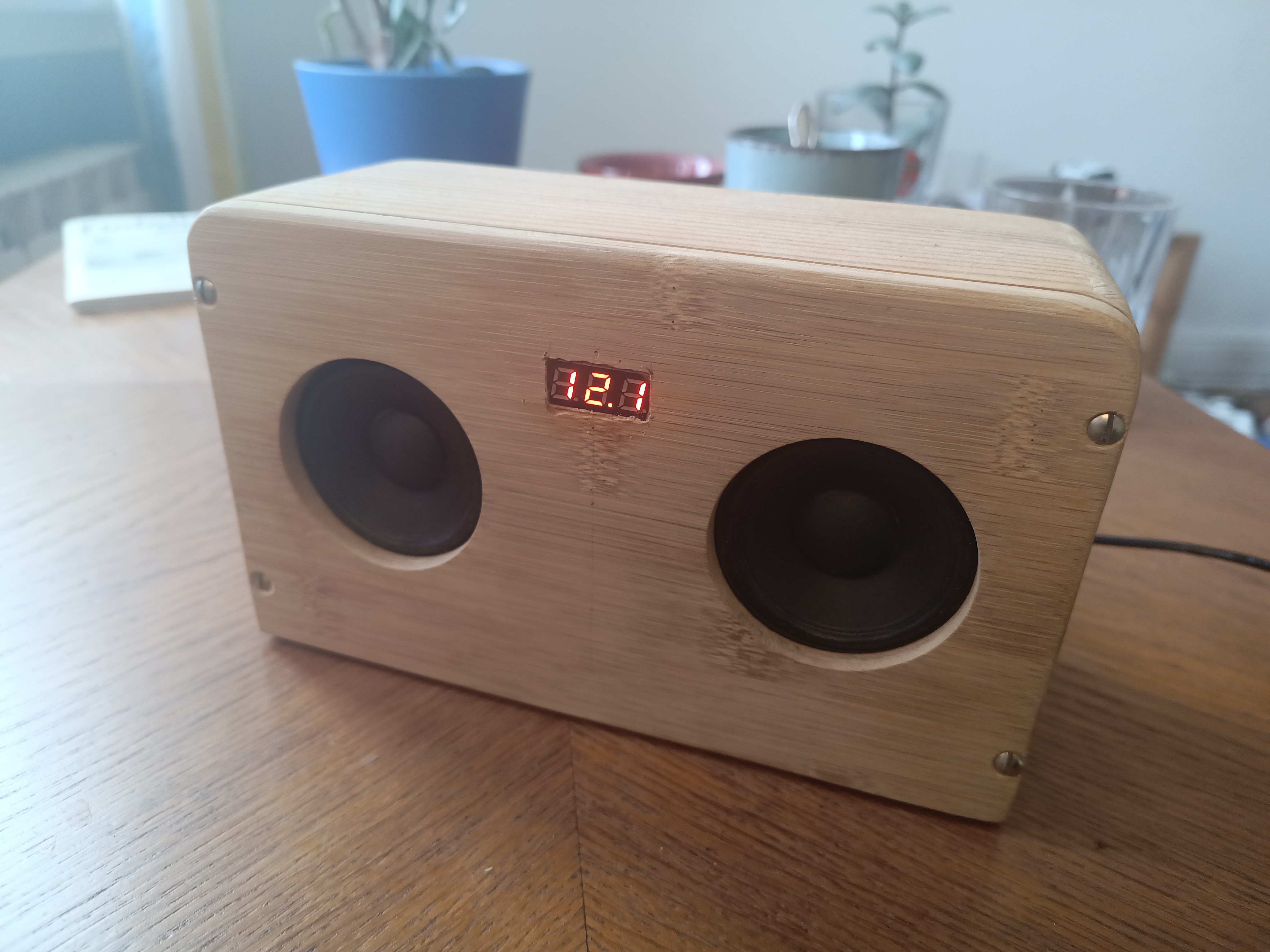
This is the write-down of a project I finished in August 2024[1].
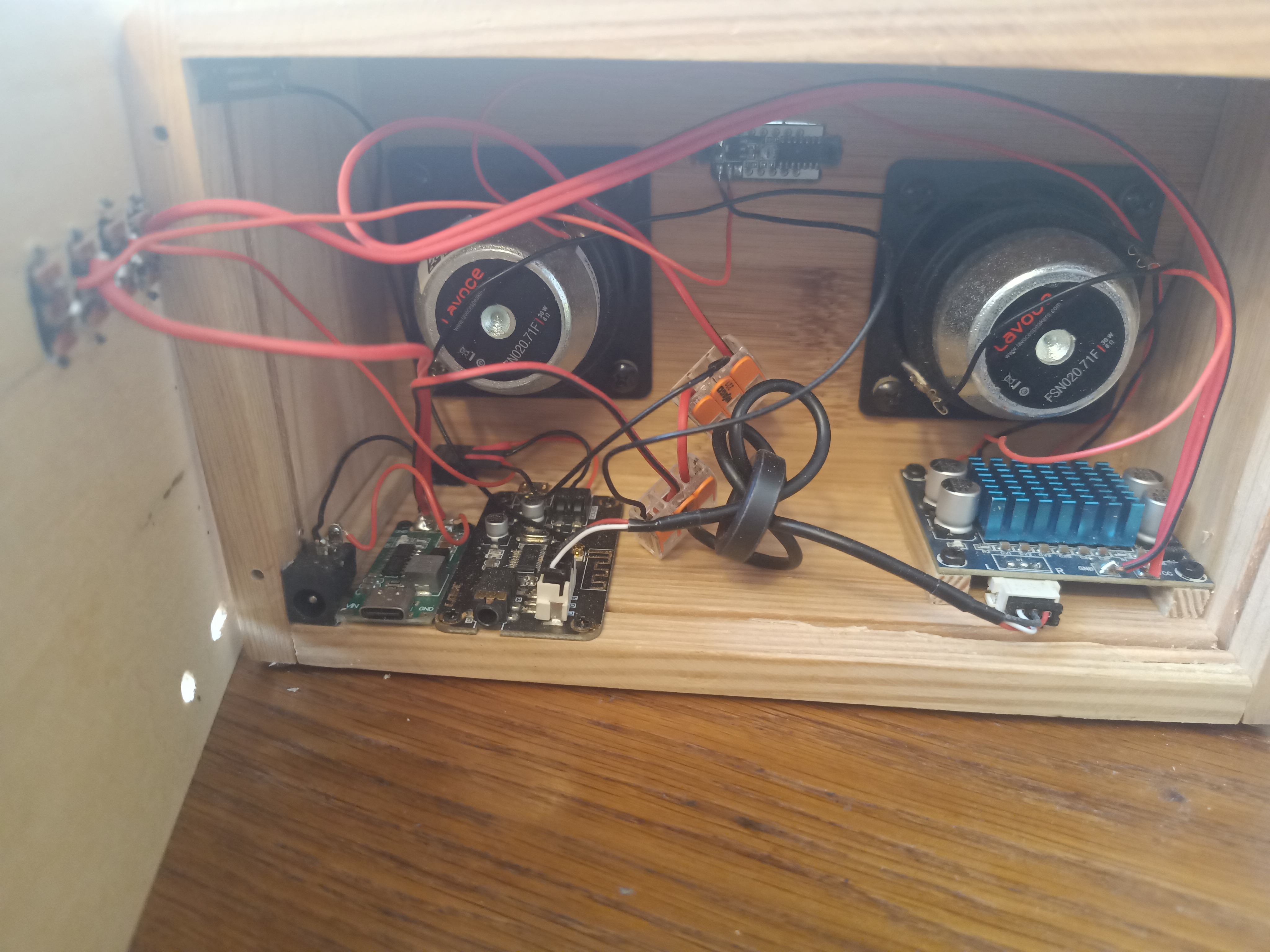
To make a music box, the first thing to choose is obviously loudspeakers. Because I wanted good sound, I opted for some high quality (i.e. not eBay sourced) speakers. I've settled on Lavoce FSN020.71F speakers. These are full-range speakers, so they can play high as well as low sounds.
To power the speakers an amplifier is needed. I've used a cheap amplifier board based on a TPA3110 stereo amplifier with 2x 30 Watts output power, which I sourced for about 5€ from eBay. As a class D (=digital) amplifier it is rather power-efficient and this one operates with an input range from 8 V to 26 V.
Nowadays, no one, including me, wants a music box without Bluetooth. So I've chosen an LQSC AS1711BT Bluetooth receiver board, which seemed to fit perfectly. It not only has a 5 V to 35 V input range thanks to an integrated down regulating circuit, but also an integrated line-out and a 3-pin connector. So I am able to use the line-out as input when Bluetooth is disabled. The connector wire that came along with it could be soldered directly onto the amplifier. I was also very happy to find out that the board wasn't using an annoying voice to announce connecting and disconnecting, but uses the much saner alternative of a short sound.
To support power over USB-C, I used a simple boost converter IC for batteries which automatically steps up the voltage to ~12 V.
I also mounted a DC jack on the output side, so that any 12 V power supply could work as well[2].
A self-powering voltmeter displays the 12 V bus voltage and serves as a battery indicator.
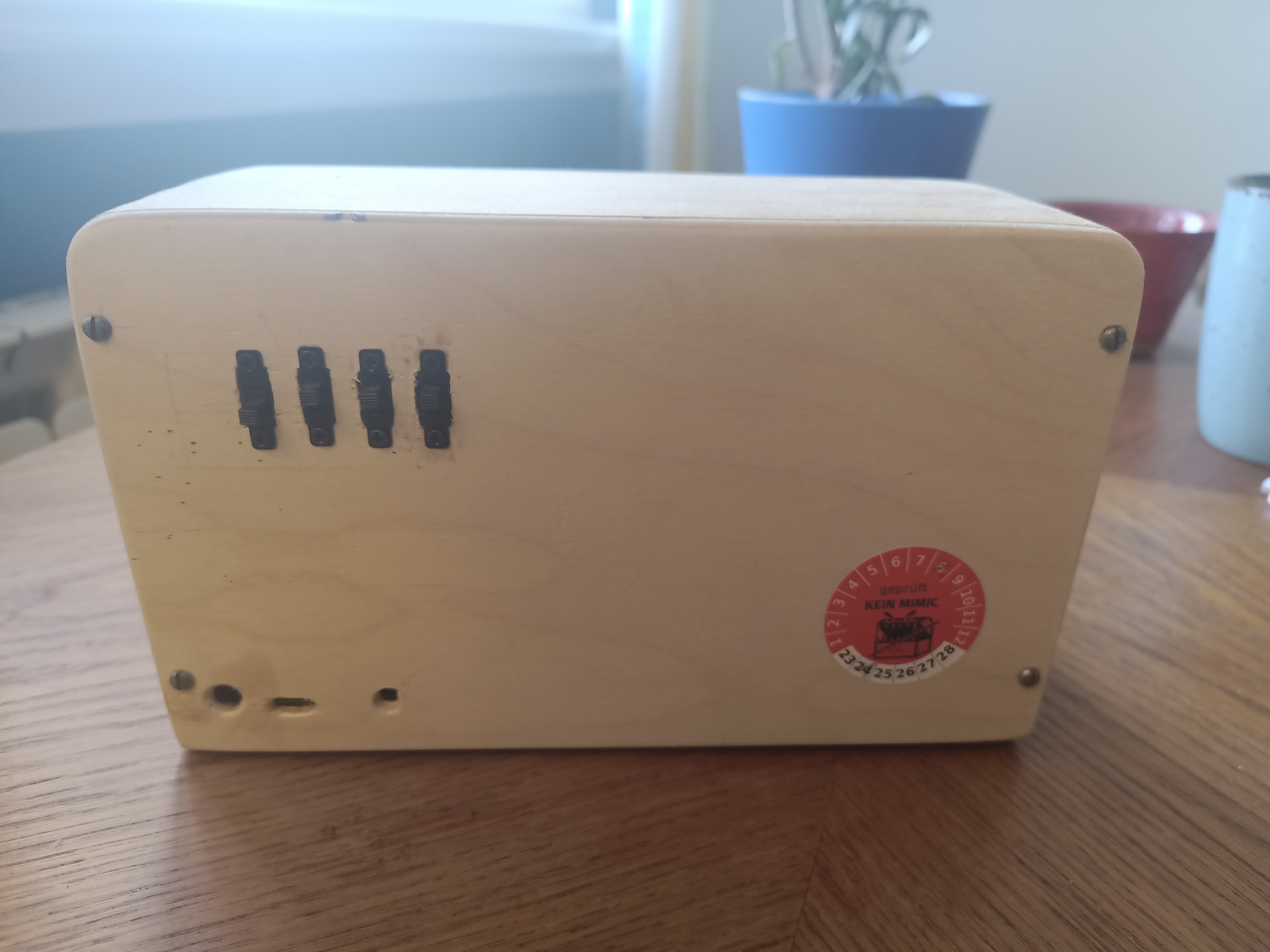
As all components are 12V compatible I've hooked them all over switches to the 12V power line. So you can choose which components are active. I've labeled them A, B, C, D, for Amplifier, Bluetooth, Charger, and Display. That makes it suitable for multiple use cases:
When the electronics arrived, I noticed a frustrating problem. As I enabled the Bluetooth receiver the amplifier was making annoying hum.
It turns out the Bluetooth chip induces spikes on the power bus and the amplifier does not like that. It took me some time to figure that one out, especially without an oscilloscope. To solve it, the suggestions were either to make a really thick GND line or use some circuit to isolate the Bluetooth chip. As the first option seemed impractical, and curiously enough I had exactly one DC-DC isolation chip lying around[3], I tried that and am happy to say it solved the problem. Except that a reverse polarity "problem" led me to buy a new Bluetooth board and a new isolation chip. The new isolation chip, an B1205S, now regulates the voltage right down to 5V which is hopefully more efficient than the built-in linear regulator in the Bluetooth board.
As I had no prior experience with woodworking, I was shocked to learn that you cannot simply cut out some wood in the right shape and glue it together. Building the case also turned out to be the hardest, most time-consuming part.
The front-wall was cut out of a kitchen cutting board. For the speaker holes I had some drills in the right size. The square hole for the voltage display was more difficult though. It was a small drill, a thin saw, and a wee bit of glue mixed with sawdust that did the trick.
The Top was built out of a wooden storage box, cut in halve, and then further down until the handle-holes disappeared. The bottom of the wooden box is now the back-panel. Cutting the holes for the switches and connectors was relatively easy despite having only one attempt.
I have bought some miniature 5mm screws that turned out to be incredibly useful because they screw themselves into the wood and fit in practically any pre-drilled PCB hole. They also hold the speakers in the hard cutting board, which is supposedly made of glue-bonded bamboo. With a bit of pre-drilling, that is.
That's how I finally finished the box, and let me say a lot of luck was involved. Sadly, the back-panel is a bit too soft, so the sound does not come out as clearly as I wished. I don't know enough about wave behaviour to really fix that. Despite this, it works fine. I also successfully used it as a Bluetooth receiver for a larger sound system.
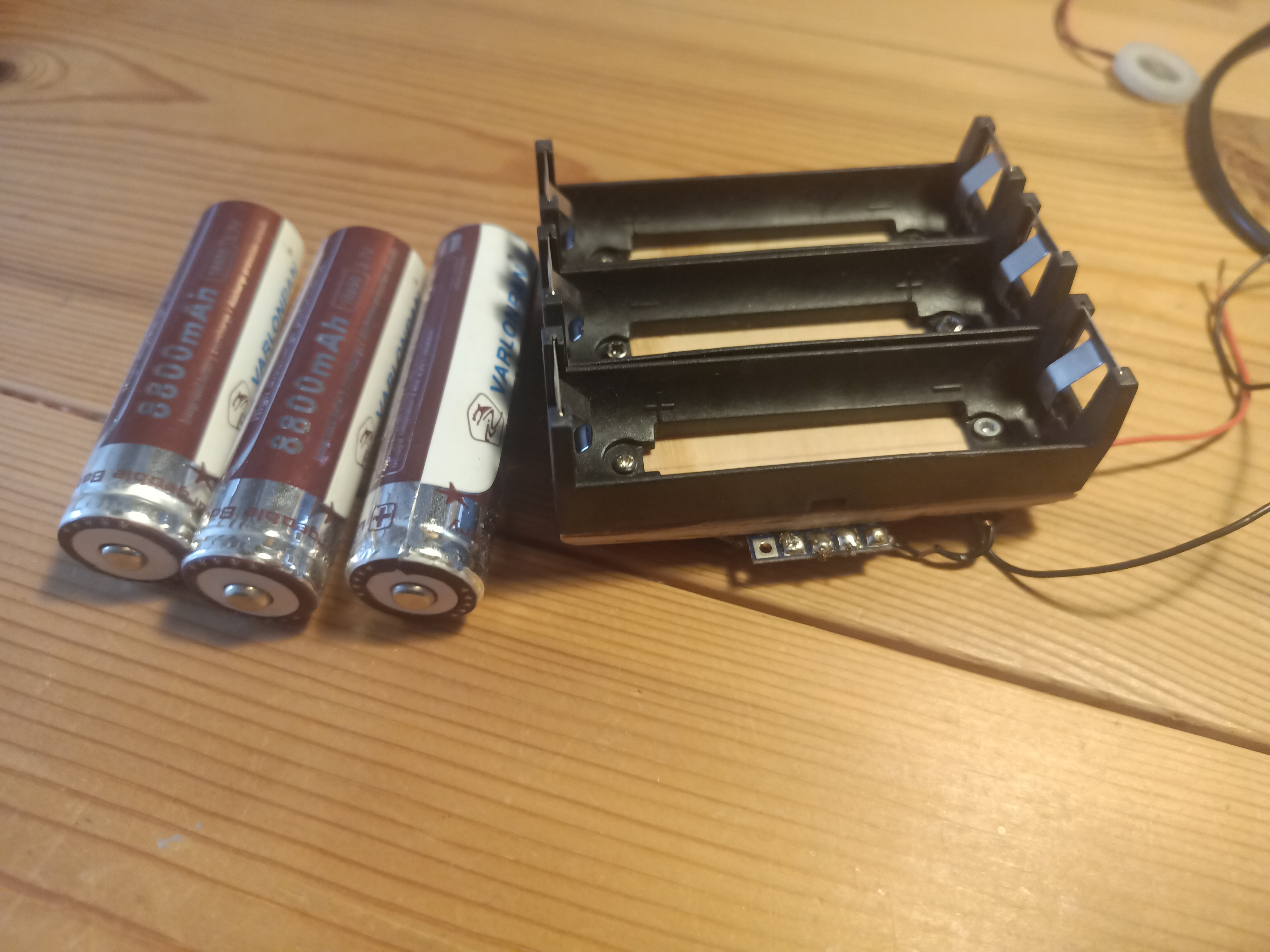
As you may have noticed the battery is missing. That's because I bought the cheap batteries (those that have more capacity than physically possible[4]) from eBay and I don't trust them enough to permanently seal them into this wooden enclosure.
As the sticker on the back just informed me. ↩
I can also connect an extra battery pack via the DC-jack and charge it over USB. ↩
I have no clue how it came into my possession, though. ↩
18650 cells top at about 3500 mAh. Mine have 8800 mAh written on them. They also say they feature an integrated protection circuit. ↩